Description
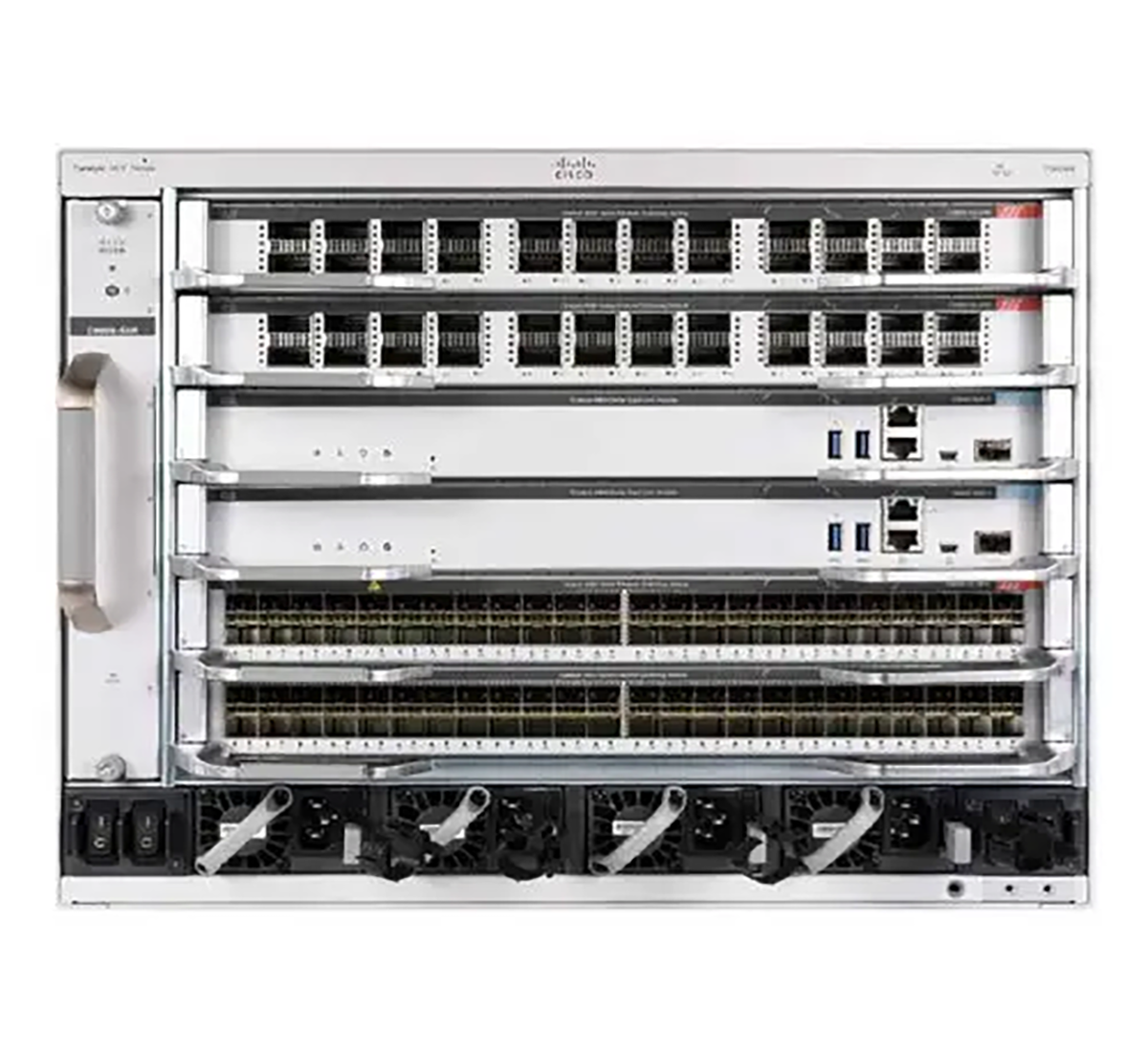
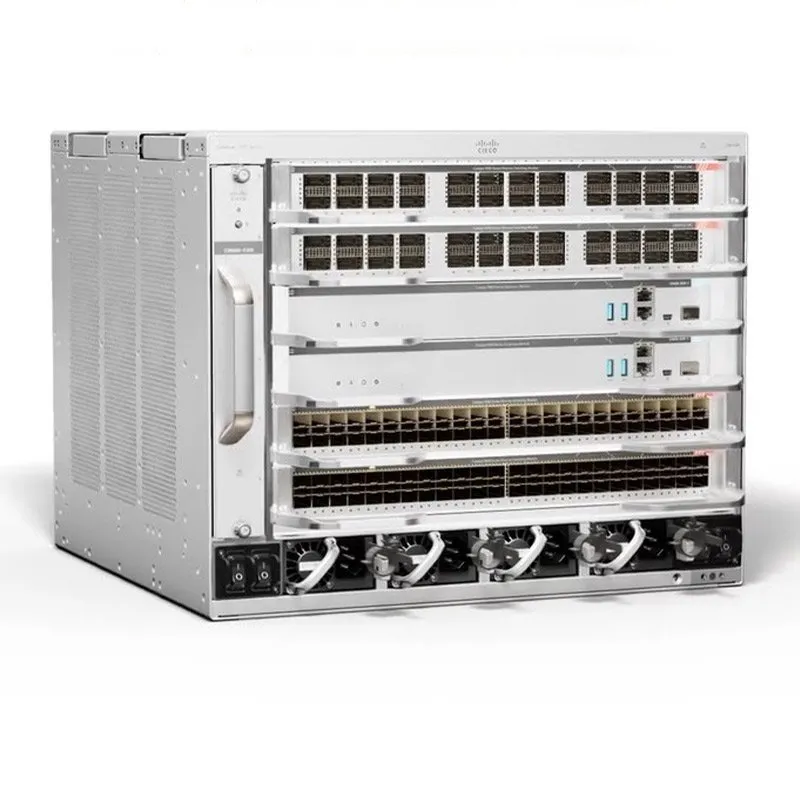
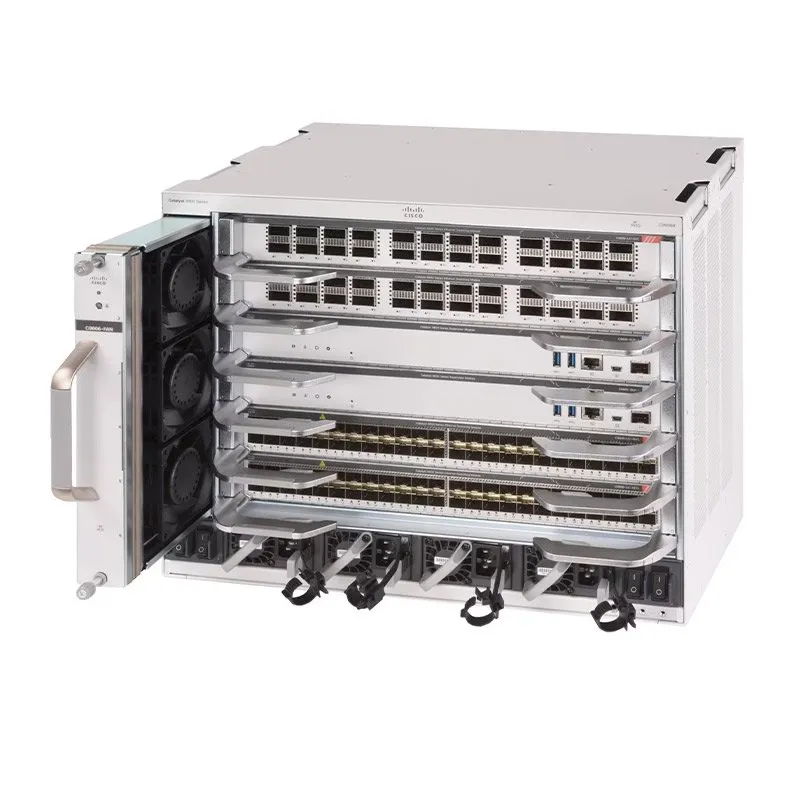
The networking landscape demands infrastructure that scales with your business while delivering uncompromising performance. The Cisco Catalyst 9600 Modular Switch Series represents a fundamental shift in modular switching architecture.
This guide examines every technical specification, configuration option, and pricing consideration for deploying Catalyst 9600 switches in Egypt. Whether you’re upgrading legacy Cisco Catalyst 6500 infrastructure or building new network capacity, you’ll find the data you need to make informed decisions.
From chassis selection through supervisor engines to line card configurations, we’ve compiled the complete resource for IT professionals evaluating this powerful switching platform.
Overview of the Cisco Catalyst 9600 Modular Switch Series
The Cisco Catalyst 9600 Modular Switch Series delivers modular flexibility for enterprise networks requiring exceptional performance and scalability. Built on the Cisco IOS XE operating system, these switches combine hardware innovation with software-defined capabilities.
Unlike fixed-configuration network switches, the modular design allows organizations to adapt port density and connectivity as requirements evolve. The architecture supports everything from basic gigabit Ethernet to advanced 100-gigabit uplinks.
Cisco designed this platform to address the growing demands of digital transformation initiatives. Security features integrate at the silicon level, while analytics capabilities provide unprecedented network visibility.
Key Platform Capabilities
The Cisco Catalyst 9600 Modular Switch Series architecture introduces several innovations that distinguish it from previous-generation Cisco catalyst switches.
- UADP 2.0 ASIC delivers 25.6 Tbps switching capacity
- Integrated hardware-based security and encryption
- Support for up to 576 10-gigabit ports in single chassis
- Modular uplink flexibility from 10G to 400G
- Software subscription model with perpetual licensing options
Target Deployment Scenarios
The Cisco Switches excel in environments where network agility and long-term investment protection matter most.
- Campus network core and distribution layers
- Data center aggregation and access switching
- High-density server connectivity
- Multi-gigabit wireless controller support
- Enterprise branch office consolidation
Platform Evolution and Market Position
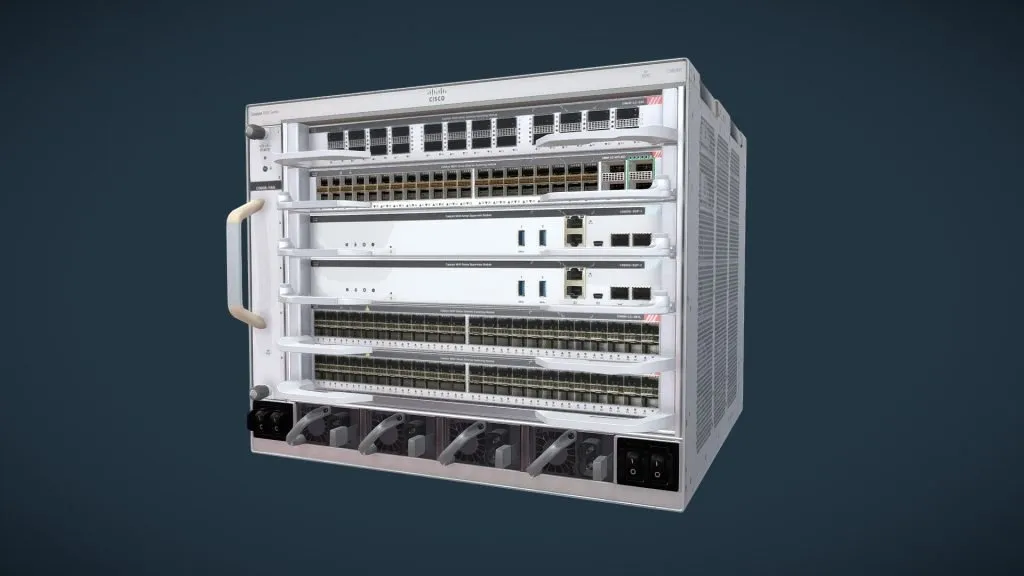
The Cisco Catalyst 9600 Modular Switch Series represents Cisco’s answer to changing network requirements. Organizations moving from the Cisco Catalyst 6500 platform find familiar modularity with modern capabilities.
Power efficiency improvements reduce operational costs compared to legacy systems. The platform consumes up to 40% less power per port while delivering significantly higher throughput.
Integration with Cisco DNA Center enables intent-based networking automation. Network management transforms from manual configuration to policy-driven orchestration.
Speak with a Cisco Catalyst 9600 Specialist
Our networking experts help Egyptian enterprises design optimal Catalyst 9600 configurations tailored to your specific infrastructure requirements and growth projections.
Chassis Configuration Options Available for the Series
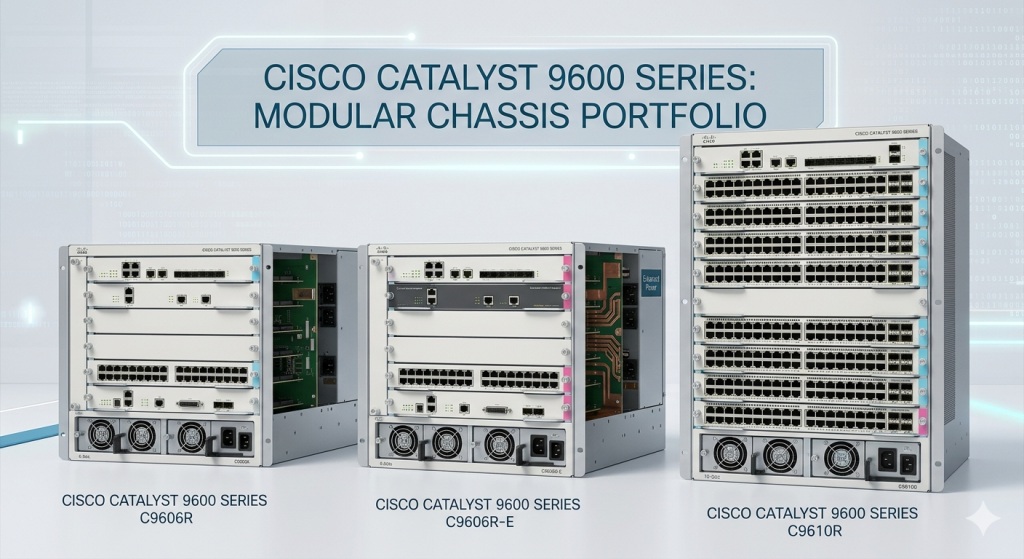
Selecting the appropriate chassis represents the foundation of your Cisco Catalyst 9600 Modular Switch Series deployment. Cisco offers three distinct chassis models, each designed for specific capacity and redundancy requirements.
The chassis determines your maximum port density, power capacity, and physical footprint. Understanding these differences ensures your infrastructure investment aligns with both current needs and future expansion plans.
Catalyst 9600 Series Chassis Models
| Chassis Model | Line Card Slots | Rack Units | Max Power Capacity | Typical Use Case |
| C9606R | 6 slots | 10 RU | 6000W | Medium enterprise deployments |
| C9606R-E | 6 slots enhanced | 10 RU | 8000W | High-power line card support |
| C9610R | 10 slots | 14 RU | 9000W | Large campus cores |
C9606R Six-Slot Chassis
The C9606R provides balanced capacity for most enterprise deployments. Six line card slots support up to 288 10-gigabit ports or 96 25-gigabit ports depending on module selection.
This chassis fits standard racks while delivering substantial switching capacity. Organizations replacing aging distribution switches find this model offers significant density improvements.
Power supplies support redundant configurations with 3000W modules. The thermal design maintains optimal operating temperatures even under full load.
C9606R-E Enhanced Six-Slot Chassis
The enhanced variant supports higher power consumption line cards. This becomes critical when deploying modules with extensive PoE++ capabilities or high-density 100-gigabit uplinks.
Power capacity increases to 8000W maximum through larger power supply units. The enhanced cooling system accommodates higher thermal loads from power-hungry modules.
Physical dimensions match the standard C9606R, allowing drop-in replacement in existing rack infrastructure. This chassis model supports all current and planned line cards without limitation.
C9610R Ten-Slot Chassis
Maximum expansion capability defines the C9610R platform. Ten line card slots enable configurations exceeding 480 10-gigabit ports or 160 25-gigabit ports.
Large campus cores and data center aggregation layers benefit from this extensive capacity. The additional slots support mixed line card deployments combining various port types and speeds.
The 14-rack-unit height requires careful space planning. However, the port density often reduces total rack space compared to multiple smaller switches.
Chassis Selection Criteria
- Current port count requirements
- Three to five year growth projections
- Available rack space and power
- Budget considerations for initial deployment
- Redundancy and high availability needs
Included Chassis Components
- Redundant fan tray assemblies
- Management module bay
- Power supply bays (modules sold separately)
- Cable management brackets
- Rack mounting hardware kit
Redundancy and Reliability Features
All Cisco Catalyst 9600 Modular Switch Series chassis support redundant supervisor engines. Dual supervisors provide stateful switchover capabilities, maintaining network availability during maintenance or component failures.
The fan tray architecture uses N+1 redundancy. Individual fan failures don’t impact system operation, and hot-swappable trays enable replacement without service interruption.
Power supply redundancy operates in multiple modes. You can configure N+1, N+N, or combined input source redundancy depending on your availability requirements.
Supervisor Configuration Details and Options
The Cisco Catalyst 9600 Modular Switch Series supervisor engine serves as the brain of your modular chassis. This critical component handles routing decisions, system management, and control plane operations.
Cisco offers multiple supervisor options optimized for different performance requirements. Understanding these differences helps you match processing power to your network’s demands.
Catalyst 9600 Supervisor Engine Models
The supervisor architecture evolved through several generations. Current options provide significant performance improvements over first-generation modules.
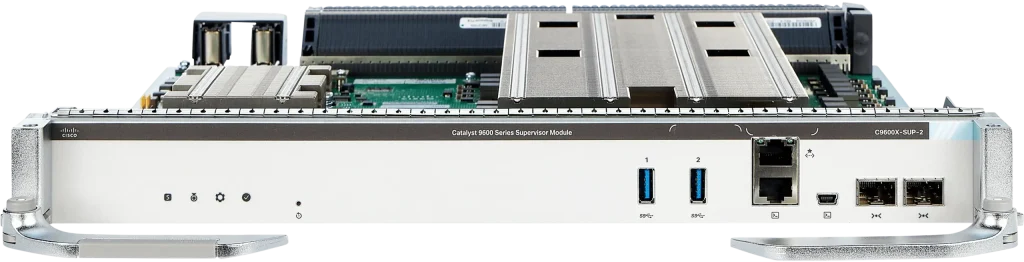
Each supervisor includes dedicated management interfaces, console ports, and USB storage for configuration backup. The module slides into designated slots at the top of the chassis.
| Supervisor Model | Forwarding Capacity | CPU Architecture | Memory | Recommended For |
| C9600-SUP-1 | 9.6 Tbps | Quad-core x86 | 16 GB | Standard deployments |
| C9600X-SUP-2 | 25.6 Tbps | Octa-core x86 | 32 GB | High-performance environments |
C9600-SUP-1 Standard Supervisor
The first-generation supervisor delivers 9.6 Tbps forwarding capacity. This proves sufficient for most campus and branch deployments where line card density remains moderate.
Processing power handles routing table sizes typical of enterprise networks. The quad-core architecture supports standard Cisco IOS XE features without performance degradation.
Organizations with budget constraints or straightforward switching requirements find this supervisor meets their needs. The lower cost makes dual-supervisor redundancy more affordable.
Catalyst 9600X Supervisor Engine
The Catalyst 9600X supervisor represents the current flagship module. Performance increases to 25.6 Tbps, matching the maximum backplane capacity of any Catalyst 9600 chassis configuration.
Enhanced processing power supports advanced features without compromising forwarding performance. The octa-core CPU handles complex security policies, analytics, and automation tasks simultaneously.
Memory expansion to 32 GB accommodates larger routing tables and extensive network telemetry data. This supervisor excels in environments running comprehensive Cisco DNA features.
9600 Series Supervisor Features
- Integrated cryptographic acceleration for secure communications
- Dual 40-gigabit uplink ports on supervisor module
- Dedicated out-of-band management ethernet port
- USB 3.0 ports for configuration storage and transfer
- Serial console port for local management access
- Hot-swappable design for maintenance without downtime
- Stateful switchover support for high availability
- Cisco UADP 2.0 programmable ASIC architecture
Supervisor Redundancy Configuration
Deploying dual supervisors transforms network availability. The active supervisor handles all forwarding and control plane operations while the standby maintains synchronized state information.
Stateful switchover occurs in sub seconds when the active supervisor fails. Network sessions persist through the failover event, maintaining uninterrupted connectivity for users and applications.
Configuration synchronization happens automatically. Changes made on the active supervisor replicate to the standby, ensuring both modules maintain identical settings.
Supervisor Selection Guidelines
Choose supervisor engines based on total chassis capacity and feature requirements. Filling a C9610R with high-density line cards demands the processing power of the Catalyst 9600X supervisor.
Budget-conscious deployments might start with single C9600-SUP-1 modules. The architecture allows supervisor upgrades without replacing the entire chassis or line cards.
Organizations running extensive security features, network analytics, or automation should prioritize the enhanced supervisor. The additional processing headroom prevents performance bottlenecks as you enable advanced capabilities.
Get Custom Catalyst 9600 Configuration Quote
Not sure which supervisor and chassis combination fits your network? Our certified Cisco engineers design optimized configurations based on your specific performance requirements and budget parameters.
Line Card Options and Their Specifications
Line cards determine the actual port configurations and capabilities of your Catalyst 9600 deployment. Cisco offers extensive options supporting everything from traditional gigabit ethernet to cutting-edge 400-gigabit connectivity.
The modular architecture allows mixing different line card types within a single chassis. This flexibility lets you match port types precisely to connected devices while optimizing costs.
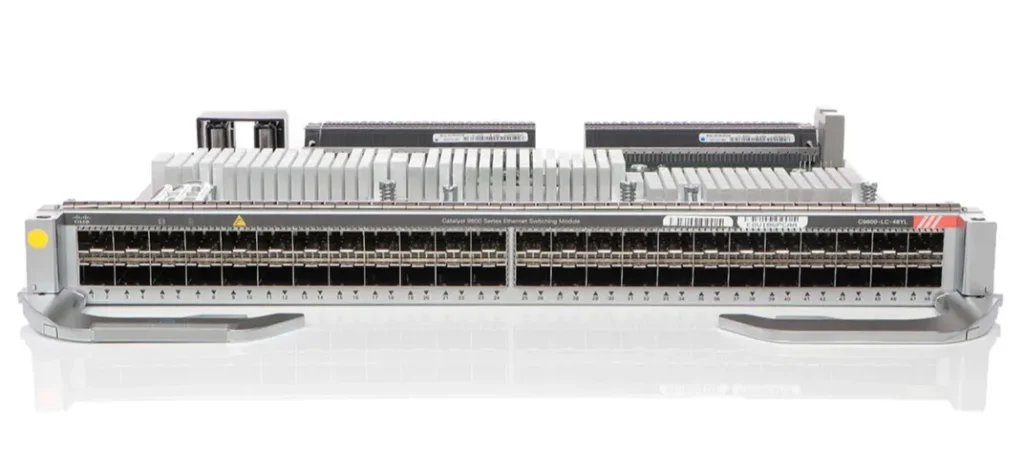
Gigabit Ethernet Line Cards
Traditional gigabit ethernet remains relevant for many access layer deployments. These line cards provide cost-effective density for connecting endpoints that don’t require multi-gigabit speeds.
The 48-port gigabit line card offers maximum copper connectivity density. Each port supports Power over Ethernet capabilities, making these modules ideal for connecting IP phones, cameras, and wireless access points.
48-Port Gigabit Line Card (C9600-LC-48YL)
This high-density module delivers 48 ports of 10/100/1000BASE-T connectivity. PoE+ support provides up to 30 watts per port for powering connected devices.
The line card includes four 25-gigabit uplink ports. These uplinks connect to core switches or provide inter-chassis connectivity in stacked configurations.
- 48 x 10/100/1000BASE-T ports with PoE+
- 4 x 25-gigabit SFP28 uplink ports
- Total PoE budget: 1440W per module
- Non-blocking architecture ensures full throughput
- Supports advanced QoS and security features
Multi-Gigabit Line Cards
The evolution of wireless technology created demand for ports exceeding gigabit speeds. Multi-gigabit ethernet supports 2.5G and 5G speeds over existing Cat5e/Cat6 cabling.
These line cards connect the latest WiFi 6 and WiFi 6E access points. The higher bandwidth eliminates wireless bottlenecks while avoiding expensive cabling upgrades.
24-Port Multi-Gigabit Line Card (C9600-LC-24C)
Each port auto-negotiates up to 5-gigabit speeds using standard copper cabling. UPOE++ support delivers 90 watts per port for power-hungry access points and devices.
Port density of 24 per module balances bandwidth with reasonable power consumption. The architecture prevents oversubscription even with all ports operating at maximum speed.
Technical Specifications
- 24 x 100M/1G/2.5G/5G copper ports
- 4 x 25-gigabit uplink ports
- UPOE++ support up to 90W per port
- 2160W total PoE capacity
- Backward compatible with gigabit devices
Ideal Applications
- WiFi 6/6E access point connectivity
- High-performance IP cameras
- Desktop connectivity for power users
- IoT device aggregation points
- Conference room systems
10-Gigabit Ethernet Line Cards
Server connectivity and storage networks demand 10-gigabit performance. These line cards provide fiber-based connectivity for high-bandwidth applications.
Multiple port density options let you optimize slot usage. The 48-port variant maximizes connections per chassis while 36-port modules offer balanced density.
36-Port 10-Gigabit Line Card (C9600-LC-36FQ)
This module delivers 36 SFP+ ports for 10-gigabit fiber connections. Each port supports various SFP+ transceivers including short-range multimode and long-range single-mode options.
Four additional 40-gigabit QSFP+ ports provide high-speed uplinks. These uplinks aggregate traffic from the 10-gigabit ports toward the network core or data center.
9600 Series 48-Port 10-Gigabit Line Card (C9600-LC-48TX)
Maximum 10-gigabit density comes from this 48-port module. Copper-based 10GBASE-T connectivity eliminates the need for separate transceivers.
The line card supports cable lengths up to 100 meters using Cat6A cabling. This proves ideal for server room and data center deployments with relatively short interconnects.
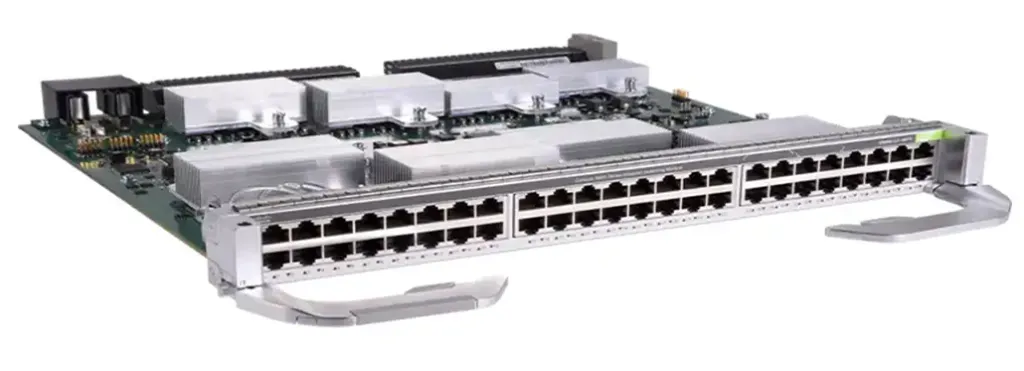
High-Speed Uplink Modules
Data center aggregation and campus core deployments require extreme bandwidth. Cisco provides line cards with 25-gigabit, 100-gigabit, and 400-gigabit capabilities.
These modules connect to next-generation switching fabrics and support future network growth. The investment protects against bandwidth limitations as application demands increase.
100-Gigabit Line Card Options
The C9600-LC-16XQ module provides 16 ports of 100-gigabit connectivity. Each port uses QSFP28 transceivers supporting various fiber types and distances.
Organizations building high-performance data center fabrics use these line cards for east-west traffic aggregation. The bandwidth supports virtualization clusters and storage area networks without bottlenecks.
Series Line Cards Comparison Matrix
| Line Card Model | Port Count | Port Speed | Uplink Ports | PoE Capability |
| C9600-LC-48YL | 48 | 1G copper | 4 x 25G | PoE+ 1440W |
| C9600-LC-24C | 24 | Multi-gig (1/2.5/5G) | 4 x 25G | UPOE++ 2160W |
| C9600-LC-36FQ | 36 | 10G fiber | 4 x 40G | None |
| C9600-LC-48TX | 48 | 10G copper | 4 x 40G | None |
| C9600-LC-16XQ | 16 | 100G fiber | Integrated | None |
Line Card Selection Strategy
Match line cards to specific network segments and device types. Access layer deployments benefit from high-density gigabit or multi-gigabit modules with PoE capabilities.
Distribution and aggregation layers require 10-gigabit or faster speeds. Server connectivity demands low latency and high throughput that fiber-based line cards provide.
Consider future requirements when selecting modules. The chassis investment lasts many years, but line cards can be added or swapped as needs evolve.
Cisco Catalyst 9600 Modular Switch Series Maximum Port Densities
Understanding maximum port configurations helps you plan chassis capacity and expansion headroom. The Catalyst 9600 series achieves remarkable density through its modular architecture.
Port counts vary dramatically based on chassis size and line card selection. Planning maximum density configurations prevents capacity limitations as your network grows.
Maximum Gigabit Ethernet Density
The C9610R chassis achieves the highest gigabit port counts. Installing 48-port gigabit line cards in all ten slots delivers 480 ports of 10/100/1000 connectivity.
This configuration includes comprehensive PoE+ support across all ports. The total PoE budget reaches 14,400 watts, powering thousands of connected devices simultaneously.
Organizations consolidating multiple access switches find this density eliminates numerous smaller devices. The reduction in switch count simplifies management and reduces power consumption.
Multi-Gigabit Maximum Configuration
Multi-gigabit deployments prioritize bandwidth over port count. The C9610R supports up to 240 multi-gigabit ports when fully populated with 24-port modules.
Each port delivers up to 5-gigabit throughput with UPOE++ power capabilities. This configuration handles the most demanding wireless deployments including high-density WiFi 6E implementations.
The total PoE capacity in this configuration exceeds 21,000 watts. This supports 90-watt access points across all 240 ports without power budget constraints.
10-Gigabit Fiber Port Density
Server connectivity and storage networks benefit from maximum 10-gigabit density. The Cisco Catalyst 9600 Modular Switch Series 48-port modules enable up to 480 SFP+ ports in a single C9610R chassis.
This extraordinary density consolidates what previously required multiple chassis. Data center top-of-rack aggregation becomes feasible in remarkably compact footprints.
The non-blocking architecture ensures full 10-gigabit throughput across all ports simultaneously. Even at maximum density, the switching fabric prevents performance degradation.
| Chassis Model | Max Gigabit Ports | Max Multi-Gig Ports | Max 10G Ports | Max 100G Ports |
| C9606R | 288 | 144 | 288 | 96 |
| C9610R | 480 | 240 | 480 | 160 |
High-Speed Uplink Capacity
Beyond access port density, uplink capacity determines how efficiently traffic flows to the core. Each line card includes dedicated uplink ports separate from access connectivity.
A fully populated C9610R with 48-port gigabit modules provides 40 additional 25-gigabit uplink ports. This substantial uplink bandwidth prevents bottlenecks even with all access ports active.
Organizations deploying 100-gigabit line cards achieve up to 160 ports of 100G connectivity. This bandwidth supports even the most demanding data center and campus core requirements.
Mixed Line Card Configurations
Real-world deployments often combine different line card types. A typical configuration might include gigabit modules for access connectivity and 10-gigabit modules for server connections.
This flexibility optimizes costs while meeting diverse connectivity needs. You pay for high-speed ports only where performance demands justify the investment.
The chassis backplane supports mixed speeds without performance penalties. A 100-gigabit module coexists with gigabit modules in the same chassis, each operating at full capacity.
Density Planning Considerations
- Current device count plus growth projection
- Power supply capacity for PoE requirements
- Cooling capacity for fully populated chassis
- Uplink bandwidth to prevent bottlenecks
- Budget for phased line card deployment
Expansion Recommendations
- Start with 60-70% slot utilization
- Reserve slots for future growth
- Plan uplink redundancy paths
- Consider supervisor upgrade timing
- Document port assignments for expansion
Power and Cooling at Maximum Density
Achieving maximum port counts requires careful power planning. Fully populated PoE configurations demand substantial electrical capacity and appropriate power supplies.
The Cisco Catalyst 9600 Modular Switch Series 3000W power supply modules provide the foundation for high-density deployments. Multiple supplies operate in redundant configurations ensuring availability even during component failures.
Cooling becomes critical at maximum density. The chassis fan trays scale airflow based on temperature sensors. Proper data center environmental controls prevent thermal issues.
Cisco Catalyst Software Subscription License SKUs and Warranty
The Cisco Catalyst 9600 Modular Switch Series operates under Cisco’s software subscription model. Understanding licensing requirements ensures compliance and access to the features your network demands.
Unlike perpetual licenses of previous generations, the subscription model provides continuous software updates and security patches. This approach keeps your infrastructure current without major upgrade projects.
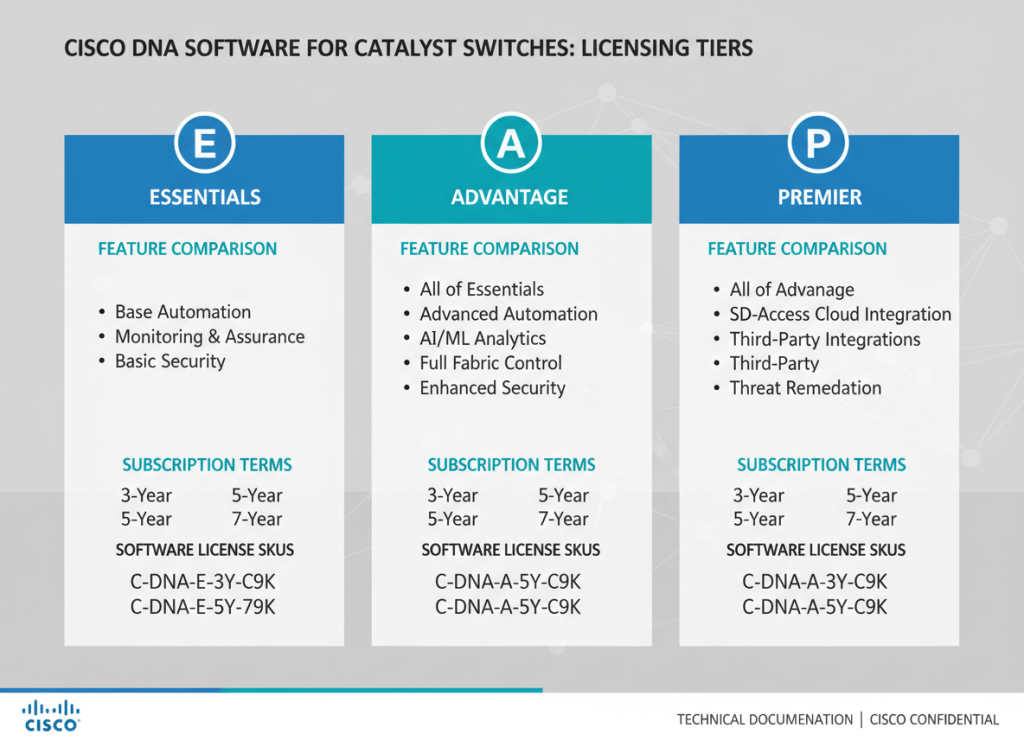
Cisco DNA Software Licensing Tiers
Cisco offers three software tiers for Catalyst switches. Each tier includes progressively advanced features supporting different use cases and requirements.
Network Essentials provides fundamental switching and routing capabilities. Network Advantage adds enhanced security and limited automation. Network Premier unlocks full DNA Center integration and advanced analytics.
Network Essentials License
The entry-level tier includes core switching functions most organizations require. Layer 2 and Layer 3 routing, basic QoS, and standard security features come with this license.
Essentials licensing works for straightforward deployments without advanced automation needs. Organizations using traditional CLI management find this tier sufficient.
- Layer 2 and Layer 3 switching protocols
- Standard access control lists and port security
- Basic QoS and traffic management
- SNMP monitoring and management
- Limited stacking and redundancy protocols
Network Advantage License
The mid-tier license adds significant security and management capabilities. TrustSec integration, MACsec encryption, and enhanced routing protocols become available.
Advantage licensing includes Cisco DNA Center compatibility for basic automation. Organizations beginning their software-defined networking journey typically start here.
- All Network Essentials features
- TrustSec and MACsec encryption
- Advanced routing protocols including EIGRP and OSPF
- Enhanced security with dynamic ARP inspection
- Basic DNA Center automation features
- Flexible NetFlow for traffic analysis
Network Premier License
Maximum functionality comes with Premier licensing. Advanced analytics, AI-driven troubleshooting, and comprehensive DNA Center integration define this tier.
Organizations implementing full software-defined networking require Premier licenses. The investment provides access to Cisco’s latest innovations as they release.
- All Network Advantage features
- Complete DNA Center integration
- AI-enhanced analytics and troubleshooting
- Encrypted traffic analysis
- Advanced segmentation capabilities
- Full automation and orchestration
- Predictive insights and recommendations
DNA Subscription Terms and SKUs
Cisco catalyst software licenses come in three, five, and seven-year terms. Longer commitments reduce annual costs but require upfront capital investment.
The subscription model includes hardware warranty coverage. Your license term determines warranty duration, eliminating separate support contracts.
| License Tier | 3-Year SKU Example | 5-Year SKU Example | Key Features |
| Network Essentials | C9600-DNA-E-3Y | C9600-DNA-E-5Y | Basic switching and routing |
| Network Advantage | C9600-DNA-A-3Y | C9600-DNA-A-5Y | Enhanced security and automation |
| Network Premier | C9600-DNA-P-3Y | C9600-DNA-P-5Y | Full DNA and analytics |
Cisco IOS XE Software Updates
Active subscriptions receive continuous Cisco IOS XE updates. Security patches, bug fixes, and feature enhancements download automatically through DNA Center or manual installation.
The update cadence provides quarterly maintenance releases and periodic feature updates. This keeps your switching infrastructure current with evolving security threats and capabilities.
Organizations can defer updates if stability concerns exist. However, running current software versions ensures access to Cisco technical support when issues arise.
Warranty Coverage and Support
Software subscriptions include comprehensive hardware warranty. The warranty term matches your license duration, covering defective components and failures.
Enhanced support options provide 24/7 technical assistance. Cisco’s technical assistance center helps troubleshoot issues and provides configuration guidance.
Hardware replacement happens through advance replacement service. Cisco ships replacement components before you return defective parts, minimizing downtime.
Warranty Services Included
- Hardware replacement for defective components
- Software updates and security patches
- Online technical documentation access
- Community forum support
- 8×5 technical assistance (upgraded with SmartNet)
- Advance hardware replacement shipping
License Management and Compliance
Cisco Smart Licensing tracks your software entitlements. The cloud-based system monitors license usage and alerts you to compliance issues.
Licenses associate with your Cisco account rather than individual devices. This flexibility allows reassigning licenses as you redeploy or retire equipment.
The system provides visibility into license expiration dates. Planning renewals prevents service disruptions when subscriptions expire.
Important Licensing Note
Cisco Catalyst 9600 Modular Switch Series require active software subscriptions to maintain full functionality. When subscriptions expire, switches continue operating but lose access to software updates and enhanced warranty services. Plan renewals 90 days before expiration to ensure continuous coverage.
Perpetual vs. Subscription Comparison
The subscription model differs fundamentally from traditional perpetual licensing. Understanding these differences helps you budget and plan deployments.
Perpetual licenses required large upfront payments but no ongoing fees. Subscriptions spread costs over time while including services previously sold separately.
Most organizations find subscriptions reduce total cost of ownership. The included warranty, support, and updates eliminate additional contract expenses.
Cisco Catalyst 9600 Price in Egypt
Pricing for the Catalyst 9600 series varies based on configuration complexity and current market conditions. Egyptian market factors including import duties, VAT, and exchange rates affect final costs.
Understanding component pricing helps you budget deployments and compare configuration options. Working with authorized Cisco partners ensures competitive pricing and legitimate products.

Chassis and Supervisor Pricing
Chassis costs represent the foundation investment. The C9606R typically starts around EGP 180,000 to EGP 220,000 depending on vendor and current market conditions.
The enhanced C9606R-E chassis commands premium pricing due to increased power capacity. Expect costs approximately 15-20% higher than standard six-slot models.
Supervisor engines add significant expense. The C9600-SUP-1 ranges from EGP 85,000 to EGP 110,000. The Catalyst 9600X supervisor costs considerably more, typically EGP 150,000 to EGP 190,000.
Line Card Pricing Overview
Line card costs vary dramatically based on port speeds and capabilities. Gigabit modules represent the most economical option while 100-gigabit cards command premium pricing.
The 9600 series 48-port gigabit line card typically costs EGP 45,000 to EGP 60,000. Multi-gigabit modules with UPOE++ increase to EGP 90,000 to EGP 120,000 range.
High-speed fiber modules escalate pricing significantly. The 48-port 10-gigabit line card ranges from EGP 110,000 to EGP 145,000. Specialized 100-gigabit modules exceed EGP 300,000.
| Component Type | Model Example | Approximate Egypt Price (EGP) | Notes |
| 6-Slot Chassis | C9606R | 180,000 – 220,000 | Base chassis only |
| 10-Slot Chassis | C9610R | 280,000 – 340,000 | Maximum expansion |
| Standard Supervisor | C9600-SUP-1 | 85,000 – 110,000 | Per module |
| Enhanced Supervisor | C9600X-SUP-2 | 150,000 – 190,000 | Higher performance |
| 48-Port Gigabit LC | C9600-LC-48YL | 45,000 – 60,000 | With PoE+ |
| 24-Port Multi-Gig LC | C9600-LC-24C | 90,000 – 120,000 | UPOE++ capable |
| Power Supply 3000W | C9600-PWR-3000W-AC | 15,000 – 22,000 | Per unit |
Software License Costs
DNA subscription licenses add recurring expenses to initial hardware investment. Network Essentials licensing typically costs 8-12% of hardware value annually.
Network Advantage subscriptions increase to approximately 15-18% of hardware costs per year. Premier licensing reaches 20-25% annually but includes comprehensive features and support.
Multi-year subscriptions reduce effective annual costs. Five-year commitments typically offer 15-20% savings compared to purchasing annual subscriptions sequentially.
Power Supply and Accessory Pricing
The 9600 series 3000W power supply modules range from EGP 15,000 to EGP 22,000 each. Redundant configurations require multiple units, impacting total deployment costs.
Fan trays, while included with chassis, may need replacement over time. Budget approximately EGP 8,000 to EGP 12,000 for fan assembly replacements.
Rack mounting kits, cable management accessories, and stacking cables add minor but necessary expenses. Factor an additional 3-5% of hardware costs for these items.
Total Configuration Examples
A typical mid-sized deployment might include one C9606R chassis, dual C9600X supervisors, four 48-port gigabit line cards, and redundant power supplies.
This configuration totals approximately EGP 700,000 to EGP 900,000 for hardware. Adding five-year Network Advantage licensing increases investment by roughly EGP 500,000 to EGP 650,000.
Large-scale deployments with C9610R chassis and mixed high-speed line cards easily exceed EGP 2,000,000 including comprehensive licensing and accessories.
Price Disclaimer
Prices listed represent approximate ranges based on current market conditions in Egypt. Actual costs vary based on specific vendor, quantity discounts, exchange rate fluctuations, and promotional programs. Always obtain current quotes from authorized Cisco partners for accurate project budgeting.
Egyptian Market Considerations
Import regulations and customs processes affect product availability and delivery timelines. Work with established distributors who handle import documentation and compliance.
Value-added tax applies to networking equipment purchases in Egypt. Factor 14% VAT into your total budget calculations to avoid surprises.
Payment terms vary by vendor and purchase size. Larger deployments may qualify for extended payment plans or leasing arrangements through Cisco capital programs.
Cost Optimization Strategies
Phased deployments spread costs over multiple budget cycles. Start with essential line cards and add capacity as budgets allow and requirements grow.
Consider refurbished equipment for non-critical deployments. Cisco Certified Refurbished products offer significant savings with warranty coverage, though availability in Egypt varies.
Volume discounts apply to larger orders. Consolidating purchases across multiple projects may unlock better pricing tiers from distributors.
Get Accurate Egypt Pricing for Your Catalyst 9600 Configuration
Receive detailed quotes including current market pricing, import considerations, and available financing options for Catalyst 9600 deployments in Egypt. Our partners provide competitive pricing with full warranty and local support.
Deployment Planning and Design Considerations
Successful Catalyst 9600 implementations require careful planning beyond component selection. Infrastructure preparation, network design, and migration strategies determine project success.
Understanding these factors before purchasing equipment prevents costly mistakes and ensures your investment delivers expected results.
Infrastructure Requirements
Rack space planning starts with chassis dimensions. The C9606R requires 10 rack units while the C9610R needs 14 units. Include additional space for cable management and airflow.
Electrical power capacity must support maximum chassis load. A fully populated C9610R with PoE line cards can draw over 9000 watts. Ensure adequate circuit capacity and redundant power feeds.
Cooling requirements increase with port density. Data center HVAC systems must handle heat dissipation from fully loaded chassis, particularly in Egyptian climate conditions.
Network Architecture Integration
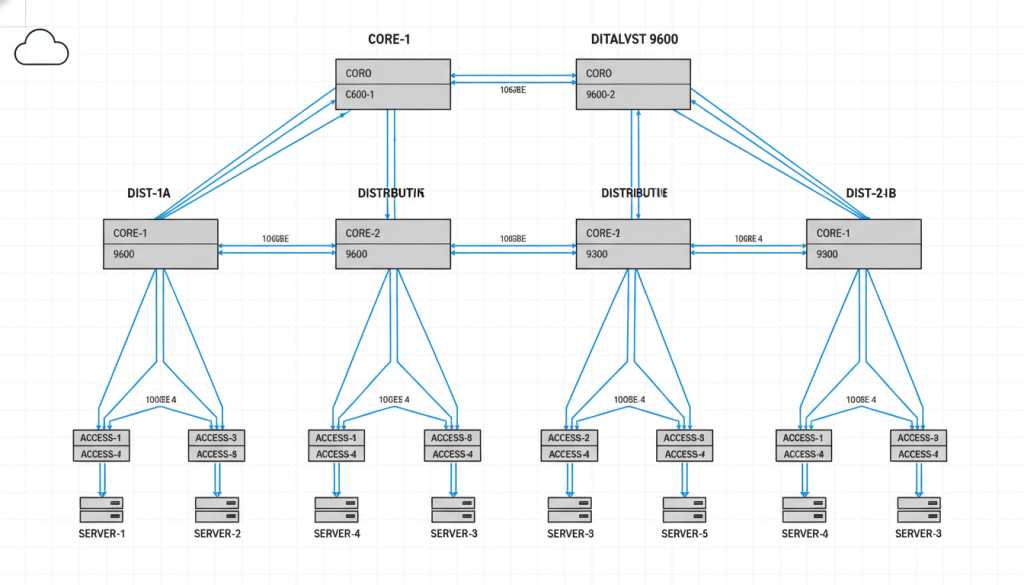
The Cisco Catalyst 9600 Modular Switch Series typically serves core or distribution layer roles. Design your topology to leverage the modular platform’s strengths while maintaining redundancy.
Uplink planning determines how traffic flows to other network segments. Use high-speed line card uplinks or dedicated supervisor ports for core connectivity.
Redundancy design should include dual supervisors, redundant uplinks, and diverse cable paths. This protects against single points of failure that could impact network availability.
Migration from Legacy Platforms
Organizations replacing Cisco Catalyst 6500 switches benefit from familiar modular concepts. However, configuration migration requires careful planning and testing.
Document existing configurations completely before beginning migration. Identify features that require different implementation in IOS XE compared to classic IOS.
Phased migration approaches minimize risk. Move traffic to new switches gradually, validating functionality before decommissioning legacy equipment.
Pre-Deployment Checklist
- Verify rack space and weight capacity
- Confirm electrical power availability
- Assess cooling and ventilation adequacy
- Plan cable pathways and lengths
- Order appropriate transceivers and cables
- Schedule installation resources
- Prepare configuration templates
- Plan testing and validation procedures
Post-Deployment Tasks
- Verify all modules operational
- Validate uplink connectivity
- Test failover scenarios
- Document as-built configuration
- Configure monitoring and alerts
- Implement backup procedures
- Train operations staff
- Establish maintenance schedule
Management and Monitoring Strategy
Decide between traditional CLI management and DNA Center automation. Your software licensing tier determines available management capabilities.
Implement comprehensive monitoring from day one. Configure SNMP, syslog, and NetFlow to provide visibility into network performance and security events.
Establish baseline performance metrics early. Understanding normal behavior helps identify problems quickly when issues arise.
How Cisco Catalyst 9600 Modular Switch Series Compares to Alternatives
The modular switching market includes several competitive options. Understanding how the Catalyst 9600 compares helps validate your investment decision.
Cisco’s platform offers unique advantages but costs more than some alternatives. Evaluating total cost of ownership beyond initial purchase price provides clearer comparison.
Cisco Catalyst 9600 Modular Switch Series vs Nexus 9000 Series
Cisco’s own Nexus 9000 provides data center-focused capabilities. The Nexus platform excels in overlay networking and application-centric infrastructure.
Catalyst 9600 better suits campus and enterprise networks. The broader Cisco catalyst ecosystem integration and familiar IOS XE interface benefit most organizations.
Pricing typically favors Catalyst 9600 for general enterprise deployments. Nexus premium pricing makes sense primarily for specialized data center requirements.
Comparison with Arista 7000 Series
Arista modular switches compete directly with Catalyst 9600. The 7000 series offers excellent performance and automation capabilities.
Arista’s software-driven approach appeals to organizations prioritizing automation and programmability. However, the ecosystem lacks Cisco’s breadth of integration options.
Total cost comparisons vary by deployment size. Arista’s simpler licensing can reduce ongoing costs, but Cisco’s DNA platform provides capabilities that justify premium pricing for many buyers.
Comparison Table: Key Competitors
| Feature | Catalyst 9600 | Nexus 9500 | Arista 7500 |
| Target Market | Enterprise campus/core | Data center | Data center/campus |
| Operating System | Cisco IOS XE | NX-OS | EOS |
| Maximum Ports | 480 x 10G | 768 x 10G | 576 x 10G |
| Licensing Model | Subscription | Perpetual | Subscription optional |
| Egypt Availability | Excellent | Good | Limited |
Why Organizations Choose Cisco Catalyst 9600 Modular Switch Series
Cisco’s extensive partner network in Egypt ensures local support and rapid equipment delivery. This matters significantly when projects have tight timelines.
Integration with existing Cisco infrastructure simplifies deployment. Organizations running Catalyst switches already possess relevant expertise and management tools.
The DNA platform roadmap promises continued innovation. Investing in Catalyst 9600 provides access to future capabilities as Cisco develops them.
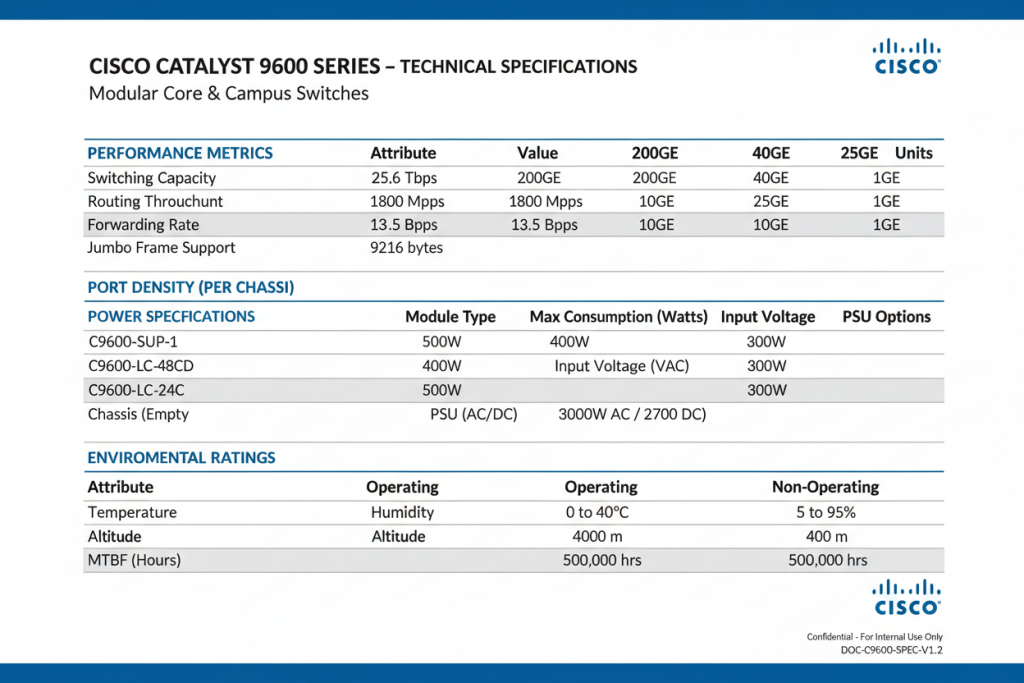
Complete Technical Specifications Summary
Comprehensive specifications help you evaluate whether the Catalyst 9600 meets your technical requirements. This section consolidates critical details across all platform components.
Chassis Specifications
| Specification | C9606R | C9606R-E | C9610R |
| Line Card Slots | 6 | 6 | 10 |
| Height (RU) | 10 | 10 | 14 |
| Width (inches) | 17.5 | 17.5 | 17.5 |
| Depth (inches) | 19.5 | 19.5 | 19.5 |
| Weight (lbs) | 85 | 90 | 125 |
| Max Power | 6000W | 8000W | 9000W |
Performance Specifications
- Switching capacity: Up to 25.6 Tbps
- Forwarding rate: Up to 19 billion packets per second
- Latency: Less than 5 microseconds port-to-port
- Routing table size: 256,000 IPv4 routes, 128,000 IPv6 routes
- MAC address table: 256,000 entries
- VLAN support: 4,094 VLANs
- Jumbo frames: Up to 9,216 bytes
- Buffer memory: 24 GB shared across line cards
Environmental Specifications
Operating temperature ranges from 0°C to 45°C for fully populated chassis. Egyptian data centers typically maintain temperatures well within this range.
Storage temperature extends from -40°C to 70°C. Humidity tolerance spans 10% to 95% relative humidity, non-condensing.
Acoustic noise levels remain under 65 dBA at normal operating loads. This allows deployment in office environments without sound isolation.
Power Supply Options
Multiple power supply models support different input voltages and capacities. AC and DC options accommodate various facility infrastructure.
| Power Supply Model | Capacity | Input Voltage | Efficiency Rating |
| C9600-PWR-3000W-AC | 3000W | 100-240V AC | 90% (80 Plus Silver) |
| C9600-PWR-3000W-DC | 3000W | 40-60V DC | 88% |
| C9600-PWR-2000W-AC | 2000W | 100-240V AC | 88% |
Supported Standards and Protocols
The Catalyst 9600 complies with extensive industry standards. IEEE 802.1Q VLAN tagging, 802.1p QoS marking, and 802.3ad link aggregation represent fundamental capabilities.
Security standards include 802.1X authentication, MACsec encryption, and TrustSec segmentation. These protect network devices infrastructure and connected devices.
Routing protocol support encompasses OSPF, EIGRP, BGP, and multicast protocols. This enables integration into complex enterprise networks.
Frequently Asked Questions About Cisco Catalyst 9600 Modular Switch Series
Can I mix different line card types in the same Catalyst 9600 chassis?
Yes, the Catalyst 9600 series supports mixed line card configurations. You can install gigabit, multi-gigabit, 10-gigabit, and 100-gigabit modules in the same chassis simultaneously.
The backplane architecture prevents performance degradation when mixing speeds. Each line card operates at full capacity regardless of other installed modules.
This flexibility allows you to optimize costs by deploying high-speed ports only where needed while using more economical modules for standard connectivity.
What happens when my software subscription expires?
Expired subscriptions don’t immediately disable your switches. The Catalyst 9600 continues forwarding traffic and maintains basic functionality.
However, you lose access to software updates, security patches, and new features. Cisco technical support becomes unavailable for expired licenses.
The enhanced warranty coverage ends with subscription expiration. You’ll need to purchase separate support contracts if you don’t renew subscriptions.
How does the Cisco Catalyst 9600 Modular Switch Series compare to the older Catalyst 6500 series?
The Catalyst 9600 offers significant improvements over legacy 6500 platforms. Performance increases dramatically with the UADP 2.0 ASIC architecture delivering higher throughput per port.
Power efficiency improvements reduce operational costs by up to 40% per port. The newer platform draws less power while delivering substantially better performance.
Modern features like DNA Center integration, enhanced security, and analytics capabilities simply weren’t available on Catalyst 6500 platforms. The 9600 represents a complete technology refresh.
Do I need DNA Center to manage Catalyst 9600 switches?
No, DNA Center is optional. The Catalyst 9600 operates perfectly well using traditional CLI management through SSH or console connections.
Many organizations continue using command-line interfaces for switch configuration and management. All features work through CLI regardless of software license tier.
DNA Center provides advantages like centralized management, automation, and analytics. However, you can deploy and operate Catalyst 9600 switches without it if you prefer traditional management approaches.
Can I upgrade from a C9600-SUP-1 to a C9600X supervisor later?
Yes, supervisor upgrades are straightforward. The modules use the same slot and connector interfaces, allowing direct replacement.
Plan for brief downtime during the upgrade if running single supervisor. With dual supervisors, you can upgrade one at a time for hitless migration.
Configuration transfers seamlessly to the new supervisor. Simply move your existing configuration and the enhanced supervisor takes over with improved performance.
What’s the difference between PoE+, UPOE, and UPOE++ capabilities?
PoE+ provides up to 30 watts per port following IEEE 802.3at standards. This powers most IP phones, cameras, and standard access points.
UPOE increases power to 60 watts per port using Cisco’s Universal Power Over Ethernet technology. High-performance access points and specialized devices benefit from this increased capacity.
UPOE++ delivers up to 90 watts per port. This supports the most demanding devices including WiFi 6E access points, digital building systems, and advanced IoT equipment.
How long does Cisco typically support Catalyst switch platforms?
Cisco generally provides 10+ years of support for Catalyst platforms from initial release. The Catalyst 6500 series received support for over 15 years.
The Catalyst 9600 launched in 2018, suggesting support will continue well into the 2030s. This long lifecycle protects your infrastructure investment.
Software updates and security patches continue throughout the support period for switches with active subscriptions. This ensures your investment remains current against emerging threats.
Are there any import restrictions for Cisco Catalyst 9600 Modular Switch Series in Egypt?
Networking equipment generally imports to Egypt without major restrictions. However, encryption capabilities may require additional documentation.
Work with authorized Cisco distributors who handle import compliance and customs procedures. They understand Egyptian regulations and manage required paperwork.
Import duties and VAT apply to networking equipment. Factor these costs into your total budget when planning deployments.
Making Your Cisco Catalyst 9600 Modular Switch Series Investment Decision
The Cisco Catalyst 9600 series represents a strategic infrastructure investment. Its modular architecture delivers flexibility that adapts as your network requirements evolve.
Success depends on matching chassis size, supervisor performance, and line card configurations to your specific needs. Organizations benefit most when they plan beyond immediate requirements to accommodate future growth.
Egyptian market considerations including pricing, import processes, and local support affect deployment timelines and costs. Working with established Cisco partners ensures you receive authentic equipment with full warranty coverage.
The software subscription model requires budget planning beyond initial hardware costs. However, the included updates, security patches, and support often reduce total cost of ownership compared to legacy perpetual licensing.
Whether you’re replacing aging Cisco Catalyst 6500 infrastructure or building new capacity, the Cisco Catalyst 9600 Modular Switch Series provides a foundation for modern networking demands. Its combination of performance, security, and management capabilities positions it as a platform that will serve your organization for years to come.
You can red more about Cisco Catalyst 9400 vs 9600 Modular Switch Comparison
Expert Configuration Assistance
Our certified network engineers help you design optimal Catalyst 9600 configurations tailored to your specific requirements and budget constraints.
For More Core Switches products
- C3850-NM-4-10G Cisco Switch
- C3850-NM-8-10G Cisco Switch
- Catalyst 9300 8X 10GE Network module
- Cisco 2960X Stacking Module C2960X-stack
- Cisco 4500 Line Card UPOE WS-X4748-UPOE+E
- Cisco Catalyst 4500 WS-C4507R-E Switch
- Cisco Catalyst 4500E Series 12-Port 10GB WS-X4712-SFP+E
- Cisco Catalyst WS-C4510RE-S7 Switch
- Cisco EHWIC 1Port SFP EHWIC-1GE-SFP-CU
- Cisco HWIC WAN Card 9Port Module HWIC-D-9ESW
- Cisco ISR 4000 Module 1Port NIM-1GE-CU-SFP
- Cisco ISR 4000 Series Module NIM-2GE-CU-SFP
- Cisco Meraki MA-MOD-4X10G Uplink Modul
- Cisco Network Interface Module NIM-ES2-8
- Cisco Nexus 9500 X9464TX2 Expansion Module
- Cisco Voice/WAN Module 4 Port NIM-4MFT-T1/E1
- WS-X4515 Cisco Catalyst 4500 Series
- Cisco Catalyst 9400 Modular Switch Series